Welcome to Sergey Verlan's home page
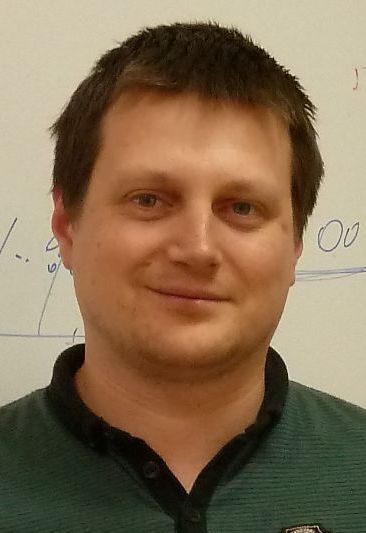
- Current position:
- Full professor at the University Paris Est Créteil, IUT de Sénart-Fontainebleau
- Email:
- verlan
 u-pec.fr
 - Phone:
- +33 (0)1 45 17 66 00
- Office:
- P2-204
- Address:
-
LACL
UFR Sciences et Technologie
Université Paris Est Créteil Val de Marne
61, av. Général de Gaulle
94010 Créteil, France
Brief outline of CV
| 2022-present | Full professor, University of Paris Est Créteil, IUT de Sénart-Fontainebleau |
|---|---|
| 2005-2022 | Associate professor, University of Paris Est Créteil, UFR Sciences |
| 2010 | Habilitation thesis, University of Paris Est. Title: Study of language-theoretic computational paradigms inspired by biology |
| 2004 | PhD at the University of Metz. Title: Head systems and applications to bioinformatics |
| 2001 | DEA (Master 2) Informatique, University of Metz |
| 2000 | Master in applied mathematics, State university of Moldova |
Research
My current research interest is in the areas of formal language theory, of natural/DNA computing, complex dynamic systems and FPGA design. I am particularly interested by the computational power of different models (decidability and computational completeness), as well as by the universality problem. I am also working on the implementation of parallel unconventional computing models in FPGA hardware with main applications in robotics. Other research topics are bioinformatics and systems biology.
Selected books
-
G. Zhang, S. Verlan, T. Wu, F.G.C. Cabarle, J. Xue,
D. Orellana-Martín, J. Dong, L. Valencia-Cabrera &
M.J. Pérez-Jiménez (2024),
"Spiking Neural P Systems: Theory, Applications and Implementations".
Springer Nature Singapore.
A comprehensive reference covering the theory, applications, and software and hardware implementations of spiking neural P systems.
-
E. Csuhaj-Varjú, M. Gheorghe, A. Leporati,
M.Á. Martínez-del-Amor, L. Pan, P. Paul, A. Păun,
I. Pérez-Hurtado, M.J. Pérez-Jiménez, B. Song,
L. Valencia-Cabrera, S. Verlan, T. Wu, C. Zandron &
G. Zhang (2021),
"Membrane Computing Concepts, Theoretical Developments and Applications",
In Handbook of Unconventional Computing,
pp. 261–339. World Scientific.
A broad survey of the fundamental concepts, theoretical developments, computational models, and applications of membrane computing.
-
G. Zhang, M.J. Pérez-Jiménez, A. Riscos-Núñez,
S. Verlan, S. Konur, T. Hinze & M. Gheorghe (2021),
"Membrane Computing Models: Implementations".
Springer.
A comprehensive presentation of software and hardware approaches for simulating and implementing membrane computing models.
Selected publications
Insertion/deletion systems
- M. Margenstern, G. Păun, Y. Rogozhin, S. Verlan (2005), "Context-Free Insertion-Deletion Systems", Theoretical Computer Science. Vol. 330(2), pp. 339-348.
Computational completeness of context-free insertion-deletion systems of sizes (3,2) and (2,3).
-
S. Verlan (2007), "On Minimal Context-Free Insertion-Deletion Systems", Journal of Automata, Languages and Combinatorics. Vol. 12(1-2), pp. 317-328
Characterization of context-free insertion-deletion systems of size (2,2).
-
A. Matveevici, Y. Rogozhin, S. Verlan (2007), "Insertion-Deletion Systems with One-Sided Contexts", In Machines, Computations, and Universality, 5th International Conference, MCU 2007, Orléans, France, September 10-13, 2007, Proceedings. Lecture Notes in Computer Science, Volume 4664, pp. 205-217. Springer
Asymmetrical systems and first incompleteness results.
-
I. Petre, S. Verlan (2012), "Matrix Insertion–Deletion Systems", Theoretical Computer Science. Vol. 456(0), pp. 80 - 88
Introduction of matrix-controlled systems.
-
S. Ivanov, S. Verlan (2015), "Universality of Graph-controlled Leftist Insertion-deletion Systems with Two States", In Machines, Computations, and Universality - 7th International Conference, MCU 2015, Famagusta, North Cyprus, September 9-11, 2015, Proceedings. Lecture Notes in Computer Science, Volume 9288, pp. 79-93. Springer.
Introduction of systems with regular contexts.
-
A. Alhazov, S. Ivanov & S. Verlan (2024),
"A 15-Year Retrospective on Insertion-Deletion Systems:
Progress, Evolution, and Future Directions",
Computer Science Journal of Moldova,
Vol. 32(3(96)), pp. 332–371.
Overview of the evolution of insertion-deletion systems from 2010 to 2024, including major results, variants, and future research directions.
-
A. Alhazov, R. Freund, S. Ivanov & S. Verlan (2022),
"Regulated Insertion-Deletion Systems",
Journal of Automata, Languages and Combinatorics,
Vol. 27(1–3), pp. 15–45.
A unified study of insertion-deletion systems equipped with sequential, time-varying, and distributed regulation mechanisms.
-
S. Ivanov & S. Verlan (2021),
"Single semi-contextual insertion-deletion systems",
Natural Computing,
Vol. 20(4), pp. 703–712.
Computational completeness results for single-symbol insertion-deletion systems controlled by permitting and forbidding contexts.
-
S. Verlan, H. Fernau & L. Kuppusamy (2020),
"Universal insertion grammars of size two",
Theoretical Computer Science,
Vol. 843, pp. 153–163.
Universality results for pure insertion grammars using rules that insert two symbols between contexts of length two.
-
S. Ivanov & S. Verlan (2017),
"Universality and Computational Completeness of Controlled Leftist
Insertion-Deletion Systems",
Fundamenta Informaticae,
Vol. 155(1–2), pp. 163–185.
Computational completeness of leftist insertion-deletion systems under graph, matrix, and random-context control mechanisms.
Membrane systems and multiset rewriting
- A. Alhazov, S. Verlan (2011), "Minimization Strategies for Maximally Parallel Multiset Rewriting Systems", Theoretical Computer Science. Vol. 412(17), pp. 1581 - 1591.
Universality of maximally parallel multiset rewriting (using only 23 rules).
- R. Freund, S. Ivanov, S. Verlan (2015), "P Systems with Generalized Multisets Over Totally Ordered Abelian Groups", In Membrane Computing - 16th International Conference, CMC 2015, Valencia, Spain, August 17-21, 2015, Revised Selected Papers. Lecture Notes in Computer Science, Volume 9504, pp. 117-136. Springer.
Definition of the maximally parallel rewriting over Abelian groups.
- S. Verlan, J. Quiros (2012), "Fast Hardware Implementations of P Systems", In Membrane Computing - 13th International Conference, CMC 2012, Budapest, Hungary, August 28-31, 2012, Revised Selected Papers. Lecture Notes in Computer Science, Volume 7762, pp. 404-423. Springer.
FPGA implementation of the maximally parallel multiset rewriting. Precomputation based on Chomsky-Schutzenberger theorem and formal power series. Spedup of order 10 5.
- A. Spicher, S. Verlan (2011), "Generalized Communicating P Systems Working in Fair Sequential Mode", Scientific Annals of Computer Science. Vol. 21(2), pp. 227-247. ``A.I. Cuza'' University Press, Iasi.
Link between fairness condition in Population protocols and Gillespie algorithm.
- R. Freund, S. Verlan (2007), "A Formal Framework for Static (Tissue) P Systems", In Membrane Computing, 8th International Workshop, WMC 2007, Thessaloniki, Greece, June 25-28, 2007 Revised Selected and Invited Papers. Lecture Notes in Computer Science, Volume 4860, pp. 271-284. Springer.
A mathematical framework for the representation of membrane systems and multiset rewriting.
- S. Verlan (2013), "Using the Formal Framework for P Systems", In Membrane Computing - 14th International Conference, CMC 2013, Chişinău, Republic of Moldova, August 20-23, 2013, Revised Selected Papers. Lecture Notes in Computer Science, Volume 8340, pp. 56-79. Springer. Invited paper.
Examples of the application of the formal framework for membrane systems.
- R. Freund, I. Pérez-Hurtado, A. Riscos-Núñez, S. Verlan (2013), "A Formalization of Membrane Systems with Dynamically Evolving Structures", International Journal of Computer Mathematics. Vol. 90(4), pp. 801-815.
The extension of the formal framework to support dynamicaly evolving structures.
- F. Bernardini, M. Gheorghe, M. Margenstern, S. Verlan (2008), "How to Synchronize the Activity of All Components of a P System?", International Journal of Foundations of Computer Science. Vol. 19(5), pp. 1183-1198.
Firing Squad Synchronization Problem for tree structures.
- S. Verlan, F. Bernardini, M. Gheorghe, M. Margenstern (2008), "Generalized Communicating P Systems", Theoretical Computer Science. Vol. 404(1-2), pp. 170-184.
Computational model based on signal synchronization and spatial displacement.
-
E. Csuhaj-Varjú & S. Verlan (2025),
"Computational completeness of minimal communication with small number
of cells",
Journal of Membrane Computing,
Vol. 7(3), pp. 236–251.
Computational completeness of generalized communicating P systems using minimal communication rules and only a small number of cells.
-
J. Liu, L. Wang, G. Zhang, S. Verlan & M. Zhu (2024),
"Universal enzymatic numerical P systems with small number of enzymatic
rules",
Theoretical Computer Science,
Vol. 1004, Article 114630.
Small universal enzymatic numerical P systems requiring only 21 linear rules, or a single rule when quadratic production functions are allowed.
-
A. Alhazov, R. Freund, S. Ivanov & S. Verlan (2023),
"Numerical networks of cells",
Theoretical Computer Science,
Vol. 958, Article 113873.
A general numerical network-of-cells framework connecting numerical P systems with several related computational models.
-
S. Verlan & G. Zhang (2023),
"A Tutorial on the Formal Framework for Spiking Neural P Systems",
Natural Computing,
Vol. 22(1), pp. 181–194.
A tutorial introduction to modelling, comparing, and extending spiking neural P systems within a common formal framework.
-
S. Verlan, R. Freund, A. Alhazov, S. Ivanov & L. Pan (2020),
"A Formal Framework for Spiking Neural P Systems",
Journal of Membrane Computing,
Vol. 2, pp. 355–368.
A general formal framework describing rule application, communication, input, and output in spiking neural P systems.
Unconventional computing FPGA implementations
-
Z. Shang, S. Verlan, G. Zhang & H. Rong (2021),
"FPGA Implementation of Numerical P Systems",
International Journal of Unconventional Computing,
Vol. 16(2–3), pp. 279–302.
An efficient FPGA architecture for generalized numerical P systems, demonstrated through real-time Sobel edge detection.
- Z. Shang, S. Verlan, I. Petre, G. Zhang (2019), "Reaction Systems and Synchronous Digital Circuits", Molecules. Vol. 24(10).
Highly efficient FPGA design for Boolean networks and reaction systems.
-
Z. Shang, S. Verlan & G. Zhang (2019), "Hardware Implementation of Numerical P Systems", In Proceedings of the 20th International Conference on Membrane Computing, CMC20, August 5-8, 2019, Curtea de Arges, Romania. , pp. 463-474.
Efficient FPGA design for Numerical P Systems.
The splicing operation
-
M. Margenstern, Y. Rogozhin, S. Verlan (2004), "Time-Varying Distributed H Systems with Parallel Computations: the Problem is Solved", In DNA Computing: 9th International Workshop on DNA Based Computers, DNA9, Madison, WI, USA, June 1-3, 2003. Revised Papers. Lecture Notes in Computer Science, Volume 2943, pp. 48-53. Springer.
Computational completeness of the iteration of the splicing operation.
-
S. Verlan, M. Margenstern (2011), "Universality of Splicing Test Tube Systems with Two Tubes", Fundam. Inform.. Vol. 110(1-4), pp. 329-342.
Universality of the long-standing problem of 2-test tube systems.
-
E. Csuhaj-Varjú, S. Verlan (2008), "On Length-Separating Test Tube Systems", Natural Computing. Vol. 7(2), pp. 167-181
A novel distributed computing model using length filtering instead of random context or target filtering.
-
A. Alhazov, Y. Rogozhin, S. Verlan (2012), "On Small Universal Splicing Systems", International Journal of Foundations of Computer Science. Vol. 23(07), pp. 1423-1438.
The smallest universal system based on the splicing operation (having only 5 splicing rules).
Other
-
E.H. Boudjema, S. Verlan, L. Mokdad & C. Faure (2020),
"VYPER: Vulnerability detection in binary code",
Security and Privacy,
Vol. 3(2), Article e100.
A concolic-execution approach for detecting exploitable taint, stack-overflow, and heap-overflow vulnerabilities directly in binary code.
-
A. Alhazov, R. Freund, S. Ivanov & S. Verlan (2025),
"Universality of Turing Tumble of Finite Size",
in Machines, Computations, and Universality – 10th International
Conference, MCU 2024, Nice, France, June 5–7, 2024, Revised Selected
Papers,
Lecture Notes in Computer Science, Vol. 15270,
pp. 72–88, Springer.
Computational universality of Turing Tumble using a finite board and bounded gear chains, with only the marble supply remaining unbounded.
- S. Verlan, A. Alhazov, I. Petre (2010), "A Sequence-Based Analysis of the Pointer Distribution of Stichotrichous Ciliates", Biosystems. Vol. 101(2), pp. 109 - 116.
Shown that AT% discriminates the positions of pointers during ciliate assembly.
- M. Margenstern, P. Mayer, S. Verlan (2011), "DNA Circuits Based on Isothermal Constrained Loop Extension DNA Amplification", CoRR. Vol. abs/1105.1424
In-vitro construction of DNA circuits based on isothermal RCA and SDA.
Teaching
I am currently responsible for the master «Conception des systèmes et cybersécurité» and I'm teaching several courses there. I'm also teaching at the Department of Computer Science, University of Paris Est Créteil and EPISEN. In 2009-2022 I was responsible for the Bachelor degree in Computer Science at our university.
Some of my past and present courses:
-
Web Application Security
Web application security based on the OWASP Top 10.
-
Penetration Testing
Introduction to penetration testing.
-
Secure Programming
Code auditing and secure programming techniques.
-
IoT Security
Security principles for connected devices.
-
DevSecOps
Introduction to DevSecOps.
-
Internet of Things
Introduction to Internet of Things concepts.
-
Rust programming
Introduction to the system programming in Rust.
-
Web Programming
PHP, JavaScript, HTML and CSS.
-
Formal Languages
Automata theory and context-free grammars.
-
Algorithms and Data Structures
Introduction to fundamental data structures.
-
Concurrent and Network Programming
Client-server programming in Java.
-
New Network Technologies
NIO and serialization in Java.
-
Compiler Design
Introduction to compiler design.
-
Databases
Introduction to SQL.
-
Operating Systems
Fundamentals of operating systems.
-
Functional Programming
Functional programming in CAML.
-
Object-oriented Design
Object-oriented design and unit testing.